


Is the Growth of Secular AA happening for the reasons you or I think it is?
For decades, Recovery Month (from alcohol and other drugs) has been celebrated in the USA and Canada.[i]
Every day of the week, 10 to 14 hours of AA for irreligious members is resonating with a community of reason-based recovery rather than a faith-in-God's-mercy alternative. These secular meetings are held in person and online, in many time zones and in several languages.
Alcohol use disorder (and other substances) is the same problem and the same solution in the meeting formats for non-believers as it is for those who pray to Allah, Shiva, a Heavenly Father or other supernatural agent: The problem is addiction whereby payoffs diminish, risks increase, but efforts to stop by oneself seem futile. The solution is community-based, with a recovery program individualized to each member. The community and/or a recovery program, along with professional help for many, clarify the problems of addiction, help identify some root causes, and provide a way to restore health to the body, mind, spirit, and relationships in home, community and professional life.
This process is articulated a little differently in every 12-Step meeting, each with its own culture and rituals. Secular meetings feature a practical, empathetic and rational language. “We aren't here to take your troubles away,” you may hear in an atheist, humanist, or freethinker meeting, “but you won't have to go through these problems alone.” Cases of recovery without Yahweh date back to 12-Step infancy. This century’s growth of secular AA meetings and groups has normalized irreligious AA.
- Signs of normalization include the Meeting Guide App, where under “communities” you can find nearby secular AA meeting times and locations, wherever you are.
- Visit Online Intergroup of AA and click on “filters, and then “Secular” to find the meetings you seek.
- The International Convention of AA now includes secular AA as one of many special composition groups (including LGBTQIA+, women’s, young people, vocation-specific, etc.).
This secular vs. faith-based 12 Step question is not a culture war in the mainstream. Also true, AA is not the same “always inclusive, never exclusive” Shangri-la in every clubhouse and every community. On either side of the issue, people have a different experience to share.
“AA without God is watered-down recovery,” fundamentalists will argue. “What you're doing isn't real AA!”
“AA would be better if we get rid of all this god-stuff,” rebels insist. “This is a program about getting real; let go of your superstitious beliefs and act your age.”
Recent statistics support the idea that AA is merely adapting to shifts in the needs and worldview of newcomers and members at large.
WHAT HAPPENS INSIDE A SECULAR 12-STEP MEETING?
Regularly, at my own home group, I hear people identifying as new to sobriety and feeling our irreligious approach better suited them. They had tried other meetings where they felt excluded and uncomfortable when everyone started praying out loud. Others with long-term sobriety in AA say that after years of trying the “only by the Grace of God” worldview, they felt more and more inauthentic, either feigning belief or biting their tongue. Rigorous honesty and an open mind are good 12-Step medicine for anyone at every stage of recovery.
Three things to keep in mind:
1. Secular AA meetings are part of AA as a whole and can participate as little or as much as the group decides. Most secular members don’t want to discount a road to sobriety through the agency of a prayer-answering, sobriety-granting higher power. Secular AA’s alternative does not imply a newer, better AA 2.0. A secular approach is about equivalency: a wider gateway, with the same efficacy as more religious members' meetings.
2. Secondly, the growing popularity of agnostic/atheist/humanist/freethinker groups and conferences is just adapting to the world we live in, which features a growing apostasy from religious concepts and rituals.
3. And third, this is a widespread 12-Step fellowship evolution which includes Narcotics Anonymous, codependency, food, sex, and other process and substance disorders.
Here are recent statistics at our quarter-Century mark, reported by Angus Reid, Cardus, and The Survey Center on American Life.
When asked, “Is religion very important to my day-to-day life?”
· Agreement of 57% of Americans: “strongly agree (33%) or “moderately agree (25%)
· Agreement of 36% of Canadians: “strongly agree (17%) or “moderately agree (19%)
· While young males show a small gain in turning to religion, the trend is that people under 50 are less religious than older people surveyed.
· All age groups have shown sharp deconversion from theistic belief and religion.[iii]
At the time of AA’s founding, 90 years ago, census data suggested only 5% of potential AA members would treat faith in gods as superstitious. Today’s members and potential members represent a broader array of worldviews, and change and creativity in many aspects of 12-Step life have always been part of it.
Here is a survey question by Angus Reid:
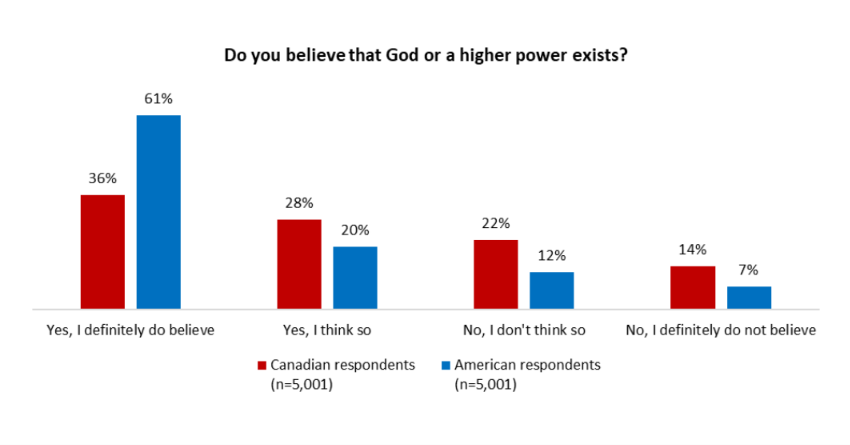
Level of certainty varies among respondents: Certain, think so, don't think so, definitely not! So does worldview. While it is interesting what direction the trend lines go, for people in or contemplating recovery, the point is that there is no right or wrong worldview. No level of doubt or certainty will determine your outcomes for recovery from addiction. To know who you are, to bring curiosity and positive regard to whatever recovery community you want to connect to, you can not only survive in recovery; thriving is realistic.
Meetings are not like a burger chain with the same menu, prices, and dining experience everywhere you go. Every recovery meeting is fashioned by the people who are engaged with it. No matter what the trending beliefs and cultures are, you can find mainstream and niche meetings and eventually you will hear what you need from people who sound just like you. Find it, dig in and get as engaged as you wish. Periodically try new meetings; your needs and preferences may change.
So here is the point:
Fewer than 40 atheist and agnostic AA groups were available at the turn of the century.
New and growing secular AA groups have grown remarkably, while overall AA membership has plateaued over the past 20 years. This secular AA growth graph looks identical to the deconversion-from-religion graph in the USA and Canada.
AA is not religious by structure—it is a benign anarchy vs. a top-down hierarchy. Groups can do what they want without vetting or review.
More religious members can find what they need in 12-Step rooms (online or in-person). Freethinkers, humanists, agnostics and strongly irreligious people with addiction can find what they are looking for.
If, in the course of your professional activities, you care for people with alcohol and other substance use disorder, consider secular AA (or other secular 12-Step fellowships) as a place where everyone will be on equal grounds, regardless of what they do or do not believe.
https://secularovereaters.org/
For families and loved ones of Alcoholics
https://srgrecovery.org/secular-al-anon/
SMART Recovery, Women For Sobriety and Life Ring all offer secular approaches. Some of the members of secular 12-Step groups also attend these meetings. Many Paths is a yes/and approach, more than a this-but-not-that approach.
See notes and links below.
[i] https://www.samhsa.gov/about/digital-toolkits/recovery-month
[ii] https://aa-intergroup.org/meetings/?tags=Secular
[iii] https://angusreid.org/canada-us-religion-cardus-spectrum-of-spirituality-comparison/
[iv] https://www.cardus.ca/research/spirited-citizenship/reports/religion-for-the-common-good/
[v] https://www.americansurveycenter.org/why-a-modest-decline-in-religious-belief-is-important/
[vi] Image above from the book Modern 12 Steps by Glenn Radder https://www.modern12steprecovery.com/